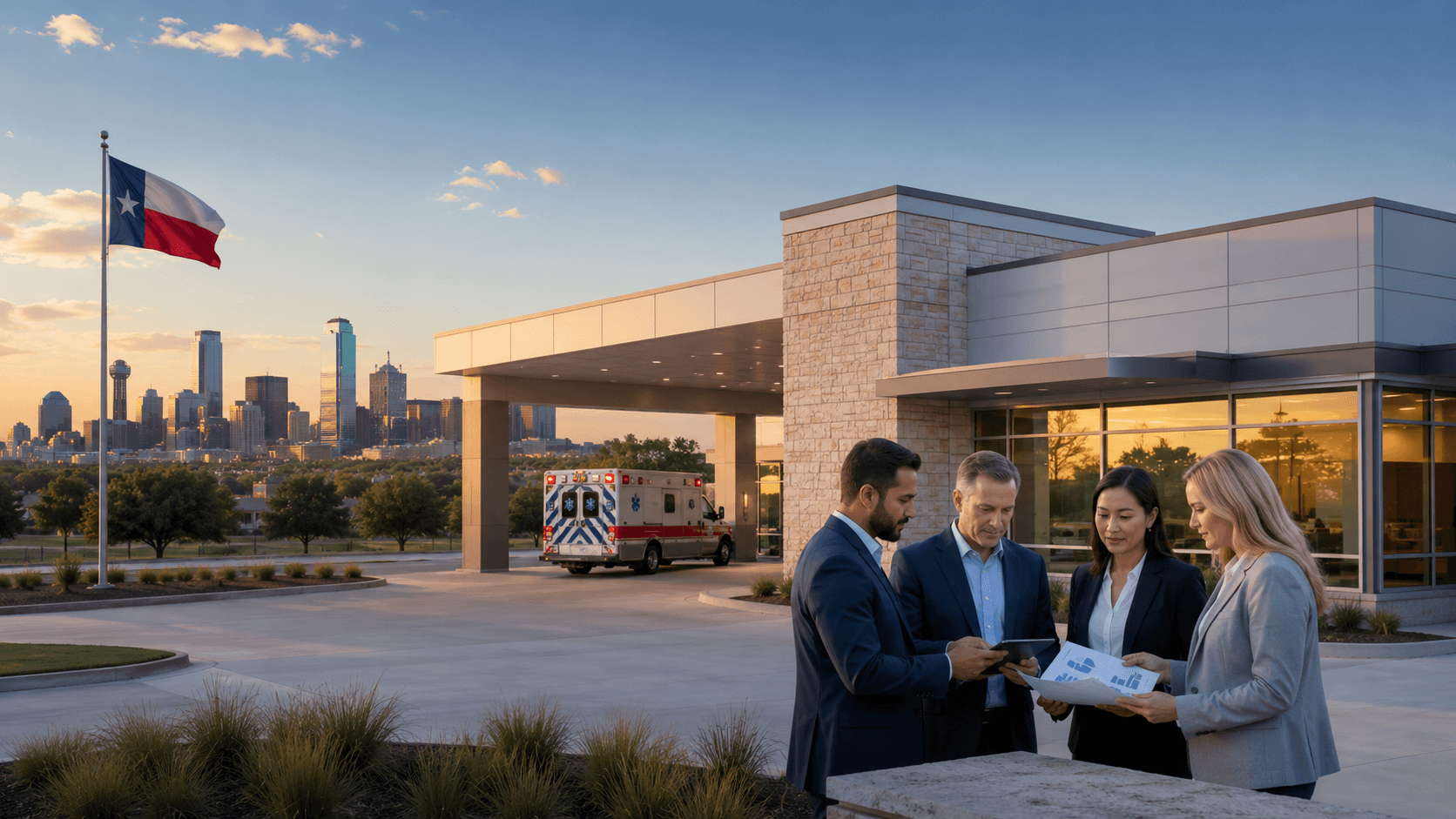
A structured guide to evaluating, financing, and launching a freestanding ER investment in Texas — from market feasibility and financial modelling to operational setup and investor ROI benchmarks.
Texas is the most active freestanding emergency room investment market in the United States. A combination of structural market factors — population growth, commercial insurance penetration, DSHS SLER licensing clarity, and sustained gap in accessible emergency care — creates conditions for well-positioned freestanding ER investments to generate compelling returns. This guide walks through the complete investor decision framework.
The investment case for Texas freestanding ERs rests on four structural pillars:
Total capital required for a Texas freestanding ER investment varies with facility size, real estate strategy, equipment scope, and location. A typical range for a standard two-to-four bay freestanding ER in a DFW submarket is:
Focus Your Finance provides a detailed capital requirements model for each investor engagement, calibrated to the specific facility scope, location, and real estate structure under consideration.
A credible freestanding ER financial model requires assumptions across several interdependent variables. The most important are:
Focus Your Finance builds integrated financial models that stress-test each assumption across optimistic, base, and conservative scenarios — providing investors with a clear view of the capital at risk and the conditions required to achieve target returns.
The path from investment decision to opened facility involves a sequence of operational and regulatory milestones that must be managed with precision. The most common causes of delay — and cost overrun — are underestimating DSHS licensing timelines and inadequate pre-opening staffing planning.
Focus Healthcare manages the operational setup workstream, including DSHS SLER licence application coordination, facility standards compliance, clinical policy development, EHR and billing system implementation, and transfer agreement negotiation. Integrating operational setup with the financial model ensures that investor capital deployment is phased correctly relative to regulatory milestones.
A well-positioned Texas freestanding ER in a high-growth DFW submarket, with appropriate marketing investment and operational execution, typically reaches cash flow break-even within 18 to 30 months of opening. EBITDA margins for mature freestanding ERs range from 15% to 35% depending on payer mix and operational efficiency.
Investors who underinvest in marketing — particularly in the first 12 months — materially extend the ramp timeline and reduce total return. Focus Marketing's patient acquisition programmes are specifically designed to accelerate patient volume ramp, and are integrated into Focus's investor support model from day one.
Focus provides investors a single multi-discipline partner across the four critical dimensions of a successful ER investment: Focus Healthcare for market feasibility analysis and DSHS licensing support; Focus Your Finance for financial modelling, capital planning, and ongoing financial reporting; Focus Data for market intelligence and performance analytics; and Focus Marketing for patient acquisition from pre-opening through sustained growth.
To discuss your freestanding ER investment, contact Focus at our Irving, TX office or via the contact form on this site.
Learn more about how Focus structures investor relationships on our investor support page, explore the operational backbone of a successful ER investment on our ER growth programme page, or review the financial modelling approach via the Focus Your Finance division overview.
Ready to evaluate a specific Texas market? Browse our city-level market intelligence pages for Dallas, Fort Worth, Irving, Frisco, and McKinney.
Editorial note: This content is produced and reviewed by healthcare business specialists at Focus. It is intended for informational purposes and does not constitute legal, medical, or financial advice.
About the Author
Focus Your FinanceDivision of Focus
A specialist division of Focus providing expert services to freestanding ER operators and healthcare businesses across Texas. Learn about our divisions →
Speak with the Focus team about ER growth, investment readiness, and healthcare business support in Texas.