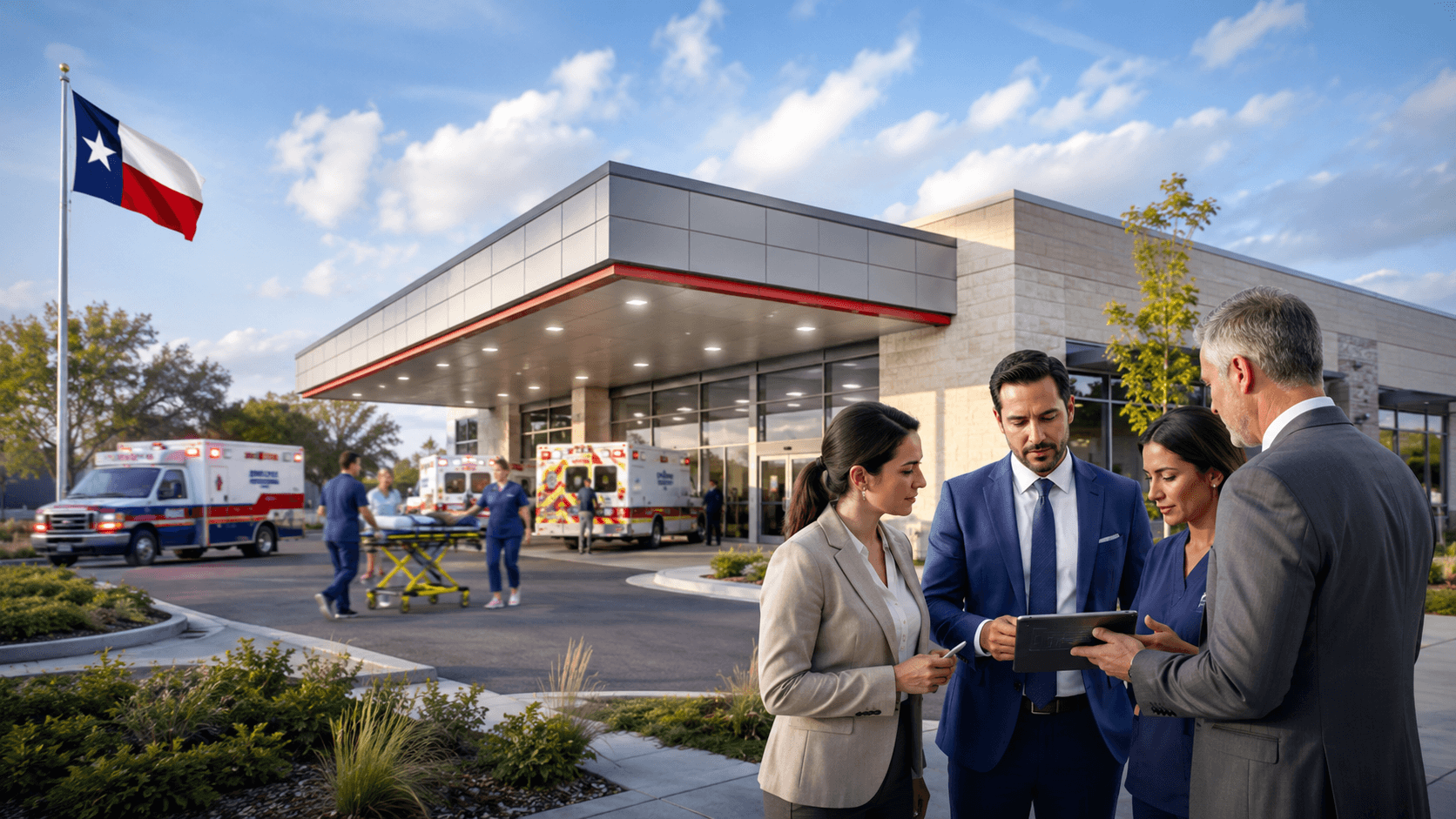
A practical guide to freestanding ER staffing in Texas: physician coverage models, nursing ratios, ancillary staff requirements, DSHS compliance, and the cost structures that determine clinical and financial performance.
Staffing is the operational backbone of any freestanding emergency room. In Texas, where freestanding ERs operate under a distinct DSHS licensing framework, getting staffing right means more than filling shifts — it means building a model that is clinically sound, financially sustainable, and compliant at all times.
Texas DSHS rules require a physician to be on-site or immediately available at a licensed freestanding emergency medical care facility at all times. In practice, this creates three common coverage architectures:
Texas DSHS mandates a minimum of one registered nurse on duty at a freestanding ER at all times. However, minimum-compliance staffing is rarely sufficient for safe and efficient operations. Best-practice operators target:
Charge nurses, lead technicians, and front-desk registration staff play supporting roles that are not always captured in DSHS minimums but materially affect patient experience and throughput.
Nurse practitioners (NPs) and physician assistants (PAs) — collectively referred to as advanced practice providers (APPs) — are an increasingly important staffing lever for Texas freestanding ERs. Under a collaborative practice agreement with a supervising physician, APPs can independently evaluate and treat lower-acuity presentations (ESI 4–5), freeing physician time for higher-acuity cases.
Operators who deploy APPs for lower-acuity tracks consistently report 15–20% improvements in door-to-provider time, a key patient satisfaction driver. The key compliance requirement is maintaining a current, DSHS-compliant collaborative practice agreement and ensuring the supervising physician is immediately reachable — not just available within the facility.
Staffing typically represents 55–65% of total operating cost for a Texas freestanding ER. The three major categories are:
Focus Healthcare provides end-to-end clinical operations support for Texas freestanding ER operators — from initial staffing model design to ongoing scheduling optimisation, DSHS compliance review, and clinical quality monitoring.
Where operators are scaling to multiple locations, Focus Healthcare coordinates staffing across sites to enable shared resources, reduce agency dependency, and build a consistent clinical culture. This is one of the four layers of the Focus Four-Layer ER Growth System — the clinical foundation on which Finance, Data, and Marketing build.
If you are evaluating your current staffing model or preparing to open a new site, speak with the Focus Healthcare team. Staffing is the clinical foundation of the full freestanding ER growth framework — see how operations, finance, data, and marketing combine to drive sustainable volume growth.
Editorial note: This content is produced and reviewed by healthcare business specialists at Focus. It is intended for informational purposes and does not constitute legal, medical, or financial advice.
About the Author
Focus HealthcareDivision of Focus
A specialist division of Focus providing expert services to freestanding ER operators and healthcare businesses across Texas. Learn about our divisions →
Speak with the Focus team about ER growth, investment readiness, and healthcare business support in Texas.