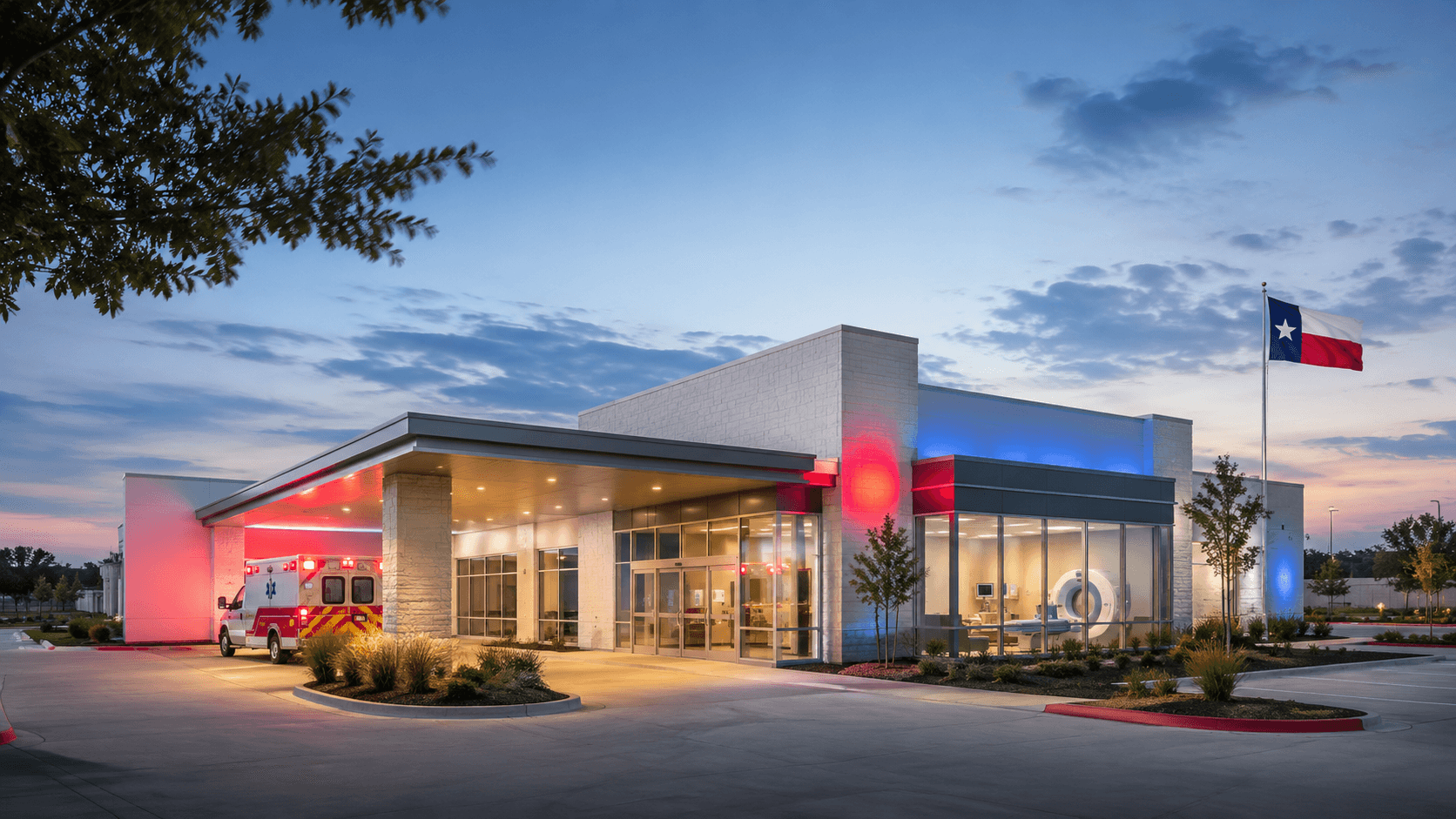
The four growth levers every freestanding ER operator in Texas needs — operations, finance, data, and marketing — and the common mistakes that slow growth down.
Growing a freestanding emergency room business in Texas requires coordinated progress across four interdependent dimensions: operations, finance, data, and marketing. Isolating any one of these from the others produces fragmented growth — improvements that do not compound and cannot be sustained at scale.
This guide breaks down each growth lever, identifies the most common mistakes ER operators make when trying to scale, and introduces the Focus Four-Layer ER Growth System — a coordinated framework designed specifically for freestanding emergency room businesses in Texas.
Operational performance is the foundation of every other growth metric. An ER with poor door-to-provider times, inconsistent compliance posture, or understaffed shifts cannot build a reliable patient experience — and without a reliable patient experience, every marketing pound spent is partially wasted.
Key operational metrics that drive growth include:
Focus Healthcare works directly with ER operators to audit, restructure, and improve operational performance — creating the clinical and administrative foundation that all other growth depends on.
Financial clarity is both a growth accelerator and an investment prerequisite. ER operators who cannot produce clean, timely financial reporting — or who lack visibility into their revenue cycle, payer mix, and unit economics — cannot attract capital, negotiate from a position of strength, or identify underperforming cost centres before they compound.
The financial infrastructure a growing freestanding ER needs includes:
Focus Your Finance provides full-scope healthcare accounting and CFO advisory services for ER operators, building the financial infrastructure that supports both operational decision-making and investor-readiness.
Data is the connective tissue between operations, finance, and marketing. Without a coherent data layer, ER operators make tactical decisions without strategic context — improving marketing spend without knowing which patient channels are actually driving revenue, or adding staff without knowing which shifts are underperforming.
Focus Data builds bespoke reporting and analytics infrastructure for ER businesses, including:
In Texas, most freestanding ER patient acquisition happens through local search. A patient in Irving, Frisco, or Katy experiencing a medical emergency searches Google, sees the local map pack, and visits the highest-rated, most visible result nearby.
For ER operators, this means local SEO, Google Business Profile management, and reputation management are not optional — they are the primary patient acquisition channel. Secondary channels including paid search, social media, and community outreach compound local SEO results over time.
Focus Marketing manages full patient acquisition systems for freestanding ERs, including local SEO, Google Maps optimisation, paid intent campaigns, review generation, and community-level digital presence. Learn more about our healthcare marketing capabilities.
Texas is the most active freestanding ER market in the United States. The state's DSHS SLER licensing framework permits independent ownership and operation without hospital affiliation, creating a uniquely permissive environment for entrepreneurial operators and institutional investors alike.
Structural demand drivers in Texas include:
Focus is headquartered in Irving, Texas, and works with freestanding ER operators and investors across the Dallas–Fort Worth metroplex, Houston, Austin, and surrounding suburban Texas markets.
After working with freestanding ER operators across Texas, the Focus team has identified a consistent set of mistakes that slow growth and destroy enterprise value:
The Focus Four-Layer ER Growth System is a coordinated framework that addresses all four growth dimensions simultaneously, through integrated specialist divisions sharing a common data layer and growth strategy.
Each layer feeds the others. Marketing drives patient volume — but only operations can absorb and retain that volume. Finance tracks the economic output — but only data makes that tracking real-time and actionable. This is why the four-layer approach produces compounding growth that isolated improvements cannot replicate.
To learn more about how Focus applies this system, visit our ER Growth & Investment services page or start a conversation with the team.
For city-specific market intelligence in Texas, explore our pages for Irving, Dallas, Fort Worth, and all Texas markets.
Consider a single-site freestanding ER in a Dallas–Fort Worth suburban market, operational for 18 months, averaging 18–22 patient visits per day. The operator is profitable but growth has plateaued. Reviews are decent but not exceptional (3.8 stars on Google). The accountant produces quarterly reports but there is no real-time financial dashboard. Marketing is limited to a basic website and occasional Facebook posting.
A typical Focus engagement for this operator would proceed as follows:
This is the compounding effect of the four-layer approach — no single intervention produces this outcome in isolation. If you are a freestanding ER operator in Texas ready to apply this framework, speak with the Focus team.
Editorial note: This content is produced and reviewed by healthcare business specialists at Focus. It is intended for informational purposes and does not constitute legal, medical, or financial advice.
About the Author
Jay DahalFounder & President, Focus
A member of the Focus leadership team specialising in freestanding ER growth, strategy, and healthcare business development in Texas.
Speak with the Focus team about ER growth, investment readiness, and healthcare business support in Texas.