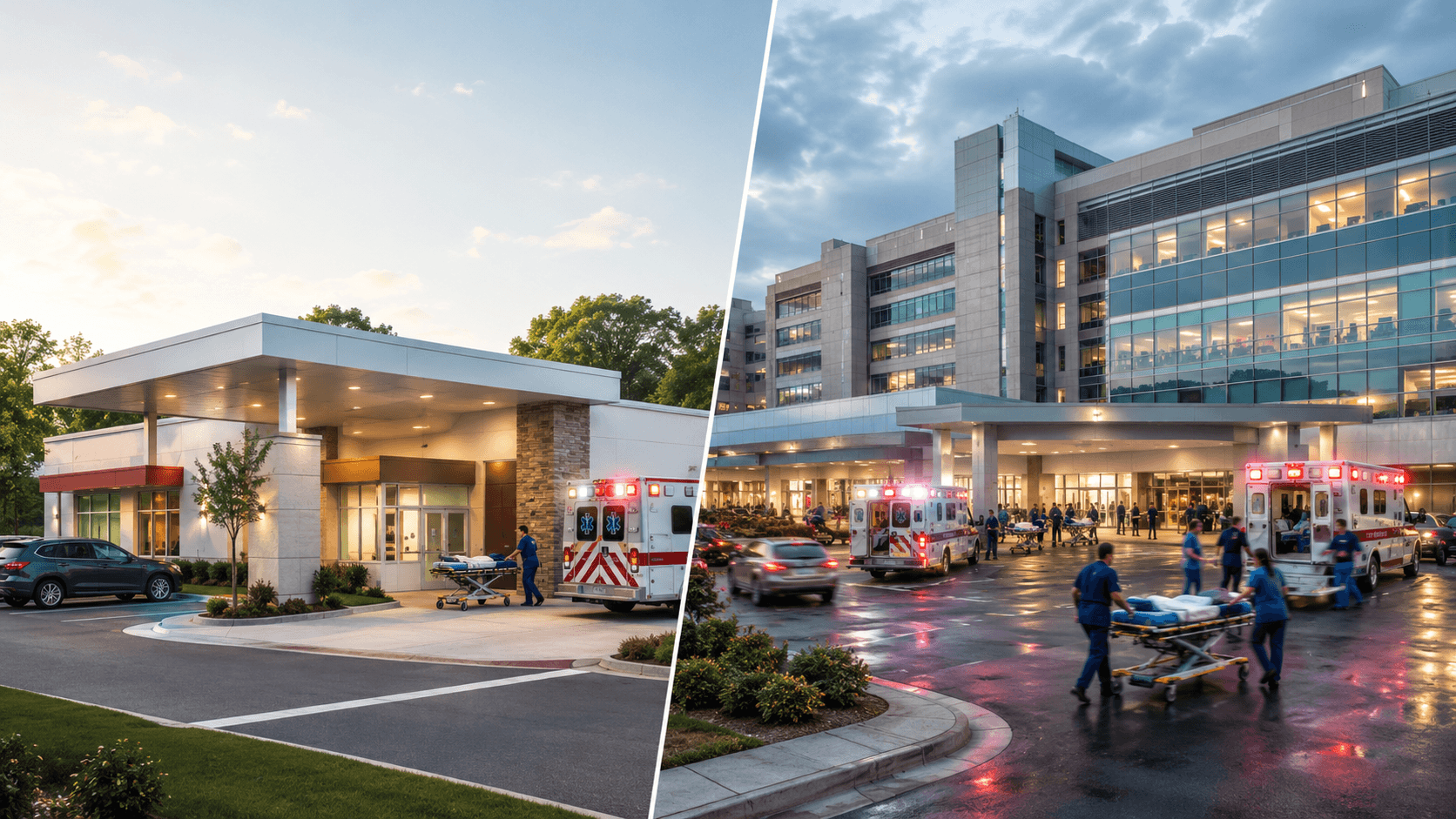
A side-by-side comparison of freestanding ERs and hospital-based emergency departments across wait times, billing, scope of services, and community access in Texas.
Freestanding emergency rooms and hospital emergency departments both provide emergency-level care, but they differ significantly in location, ownership structure, patient volume, billing practices, and the range of services available. Understanding these differences matters — whether you are a patient choosing where to seek care, an operator evaluating a market, or an investor assessing a healthcare asset.
The table below summarises the key differences between a freestanding ER and a hospital-based ED in Texas.
| Dimension | Freestanding ER | Hospital ED |
|---|---|---|
| Location | Community / suburban, standalone | On or adjacent to hospital campus |
| Licence (Texas) | DSHS SLER | Part of hospital licence |
| Ownership | Can be independently owned | Must be hospital-affiliated |
| Staffing | EM physician required when open | EM physicians + specialist access |
| Inpatient admission | Transfer to hospital required | Direct admission on-site |
| Average patient volume | Lower | Higher |
| Billing model | Emergency rates (facility + physician) | Emergency rates (facility + physician) |
| Typical wait time | Shorter (lower volume) | Longer (higher volume + acuity mix) |
One of the most consistently cited advantages of freestanding ERs is faster door-to-provider time. Because FSERs operate at lower overall patient volumes than major hospital emergency departments, the patient queue is typically shorter for non-critical presentations.
Hospital EDs, particularly those attached to Level I and Level II trauma centres, manage a far broader and higher-acuity case mix — including major trauma, complex surgical emergencies, and critical presentations that require inpatient resources. This case complexity naturally increases average wait times for non-critical patients in the queue.
For ER operators, wait time is a key marketing and retention metric. Consistently short door-to-provider times drive positive reviews, word-of-mouth referrals, and return-visit consideration. This is one area where Focus Data's analytics and reporting capabilities add direct commercial value — tracking door-to-provider times in real time and flagging operational bottlenecks before they affect patient experience.
This is the area of highest complexity for patients — and one of the most significant strategic considerations for freestanding ER operators.
Both freestanding ERs and hospital EDs bill at emergency rates. Patients typically receive two separate charges: a facility fee (for the use of the emergency facility and its equipment) and a physician fee(for the attending emergency physician's services). This billing structure is identical to a hospital ED visit.
The critical difference lies in insurance network participation. Many freestanding ERs in Texas operate out-of-network with major commercial insurers. This can result in significantly higher out-of-pocket costs for patients whose plans do not include FSER coverage, and has been a source of regulatory scrutiny in Texas and nationally.
For ER operators, insurance contracting strategy — which networks to join, how to negotiate rates, and how to communicate billing clearly to patients — is a material operational and financial decision. Focus Your Finance supports ER operators in evaluating and structuring their insurance contracting approach as part of broader ER growth strategy.
A Texas-licensed SLER is required to maintain the capability to evaluate, stabilise, and treat emergency conditions. Required capabilities include:
What a freestanding ER cannot provide is inpatient admission. Where a hospital ED can admit a patient directly to an ICU, surgical floor, or observation unit, a freestanding ER must stabilise and arrange transfer. This means FSERs are not appropriate as the sole destination for presentations that will definitively require surgical intervention or multi-day inpatient management.
The location flexibility of freestanding ERs creates meaningful community access advantages in underserved suburban and exurban markets.
Texas has experienced sustained population growth across the Dallas–Fort Worth metroplex, Houston's outer suburban ring, Austin, and numerous mid-sized communities. Many of these high-growth areas lack a hospital within practical emergency transport distance. Freestanding ERs can be positioned in these communities ahead of hospital development, filling a genuine emergency care gap.
For investors and operators, this access dynamic is a primary demand driver. Communities without nearby emergency care generate high utilisation at new FSER locations because there is no competitive hospital ED redirecting patients. Focus consistently identifies community access gaps as part of its market analysis when supporting ER growth strategy in Texas.
Editorial note: This content is produced and reviewed by healthcare business specialists at Focus. It is intended for informational purposes and does not constitute legal, medical, or financial advice.
About the Author
Rick LeonardDirector of Operations, Focus Healthcare
A member of the Focus leadership team specialising in freestanding ER growth, strategy, and healthcare business development in Texas.
Speak with the Focus team about ER growth, investment readiness, and healthcare business support in Texas.